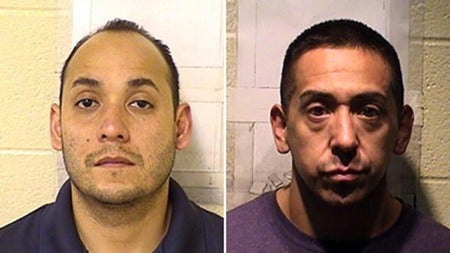
Tiffany Van Dyke Speaks to Husband For First Time | Jason Van Dyke
Jason Van Dyke and wife Tiffany leave the Leighton Criminal Courthouse in September. | Ashlee Rezin/Sun-Times
By Michael Sneed
The Van Dyke file . . .
Tiffany Van Dyke — who tells Sneed she hadn't talked to her husband, former Chicago police officer Jason Van Dyke, since his transfer to a medium-security New York correctional facility — finally talked to him Thursday. “He's OK,” said Tiffany, who was unsure when her husband was actually moved since being attacked last month by prisoners at a federal facility in Connecticut, where he was first sent after leaving Illinois. She now plans to gather all the frequent flyer miles she's been sent by well-wishers to visit her husband, who is serving a 6-year, 9-month prison sentence for the murder of 17-year-old Laquan McDonald, whom he shot 16 times. Van Dyke is now being held in isolation at the medium-security federal prison in Otisville, N.Y. In a message forwarded to Sneed, Tiffany stated: “I heard the news about the Illinois Supreme Court ruling [rejecting a bid from prosecutors to re-sentence her husband to what could have been a harsher prison term], from a friend who had seen it on Twitter.” “I am very grateful to the Illinois Supreme Court for not increasing Jason's prison sentence and looking at this case objectively and without bias,” she said. “This has been devastating for our family, especially so for our two daughters. Now we can try to move on. I want to thank our lawyers, Dan Herbert, Tammy Wendt, and Randy Rueckert for all that they have done for my husband and our family, both in the courtroom and in our daily lives.”
YOUR ESTATE PLANNING CHECKLIST: 4 IMPORTANT TASKS TO PRIORITIZE RIGHT NOW
June 2022 (Chicago, IL)
If you're like many Americans, you might find estate planning to be an uncomfortable or even stressful topic to address. Indeed, a 2022 survey from Caring.com revealed that although the majority of Americans understand the importance of having an estate plan, a staggering 68% do not currently have one.
The survey reports various explanations for why this discrepancy exists. Regardless of the reasons why people consistently deprioritize the task of creating an estate plan, it's difficult to understate the importance of doing so. Not accounting for what will happen to you and your assets if the unexpected occurs can open you and your loved ones to substantial risk and unwanted consequences. The absence of an estate plan can result in a total loss of control over your own affairs in the event of an unplanned life-altering event, such as a car accident or health crisis. Such events can also create unwanted confusion and tension for your loved ones.
Without an estate plan in place, the statutes of the state where you reside will dictate some of life's most important decisions for you. Organizing an estate plan right now – while you're of sound mind and body – ensures that you are in control of your future.
While there are many issues to consider with a comprehensive estate plan, here are four tasks that you should move to the top of your priority list.
Document Your Health Care Wishes with a Living Will
A living will is an advance directive that indicates the specific types of medical care that you wish to receive if you are no longer able to make such decisions (due to a terminal illness or being permanently unconscious). This includes your preferences with regards to resuscitation procedures, ventilators, tube feeding or other life-sustaining medical procedures.
Designate a Medical Power of Attorney
An unexpected illness or injury can render you incapacitated and unable to make critical decisions about your own well-being. In these circumstances, you must grant someone else the legal authority to make those decisions on your behalf.
A medical power of attorney, also known as a health care proxy, is a legal document that authorizes one or more people to make important medical decisions on your behalf should you become physically or mentally incapacitated. Most people assign their spouse or partner as their primary health care agent and one of their children or a close family member or friend as an alternate agent should their primary agent also become incapacitated or pass away.
Create Medical Orders for Life Sustaining Treatment (MOLST)
Also known as a Physician's Orders for Life-Sustaining Treatment (POLST), this outlines a plan of end-of-life care that reflects both your preferences and your physician's judgment based on your medical evaluation. This form can be created even if you're not ill: it only goes into effect if you're facing an end-of-life situation.
It's important that your loved ones are aware of your medical treatment preferences and health care wishes before an unexpected crisis takes these decisions out of your hands.
Choose An Executor
An executor is an individual of your choosing who will become responsible for managing the distribution of assets in your estate if you are unable to do so due to illness or death. These assets include your home, investments, vehicles and other valuable items.
An executor does not need to be a legal professional. In fact, anyone can serve as executor, including a family member, your children or a close friend. Regardless of who you choose for this role, make sure they are aware of your decision and that they understand their responsibilities.
Protect Your Financial Interests
Part of protecting your financial interests involves designating a financial power of attorney to give control of your finances to someone else, should you no longer be able to manage them yourself. Like a health care proxy, a spouse or partner is often assigned to this role.
Assign a Financial Power of Attorney
A durable financial power of attorney grants a designated individual the ability to manage your financial affairs if you're medically unable to do so. As directed in your document, this designated agent can act on your behalf in legal and financial situations if you should become incapacitated.
This decision involves determining who will pay your bills and taxes on your behalf, when and how the power of attorney takes effect, and whether your designee is granted access to your finances and assets immediately or only after a specific event (such as a hospitalization).
Although you can elect anyone to serve in this role, this individual should preferably have a strong understanding of personal finance and investing. If a health care crisis requires them to intercede on your behalf, they will need to make critical decisions that could involve significant adjustments of your investment strategy and withdrawals from your bank accounts to fund any medical and long-term care expenses.
Finalize Your Will
Ideally, you've created a will that specifies how your assets will be distributed. You should strongly consider discussing this information with your heirs, especially if they're under the mistaken assumption that they'll be inheriting the bulk of your estate. In the event that this isn't true — for example, if you wish to leave most of your assets to charity —it's generally better to inform your heirs of this decision sooner rather than later.
Once you've made decisions about these critical issues, it's important to communicate them ahead of time to those who will be impacted: make it easy for people to access the information that they will need in order to carry out your wishes. Ideally, the individuals named in your estate plans should have access to the following documents:
Copies of your health care and financial proxy forms
Copies of your life insurance policies
Contact information for your primary care physician, attorney, accountant, financial adviser, life insurance agent or any other professionals they may need to contact in a health care emergency or after your death
Any interment agreements you've made with a funeral home or cemetery
Thinking through end-of-life issues can cause some anxiety. But creating an estate plan may ultimately be one of the most rewarding tasks that you undertake. Making these decisions now – while you're still physically and mentally healthy – provides a profound and powerful sense of accomplishment. Planning ahead allows you to be confident in knowing that some of life's most important decisions will be handled on your terms when the time comes.
Getting Started
For the average American, the most challenging part of estate planning can be knowing where to start. Most of us know we should have some sort of plan in place to protect our assets and ensure our loved ones are cared for when we are gone, but the steps necessary to make that happen can be confusing.
If you've been meaning to create an estate plan but don't know where to begin, let us help.
WHISTLEBLOWER RETALIATION IN ILLINOIS – Legal – HERBERT LAW FIRM
November 2021 (Chicago, IL)
Exposing corruption, unethical behavior or misconduct within an organization provides tremendous value to the local community. Employees who report workplace misconduct – often referred to as “whistleblowers” – help to keep the powerful and unscrupulous in check, making sure that fellow and future employees, shareholders, and other stakeholders are protected against illegal activity that threatens public safety, health and financial well-being.
Despite its ethical nature and value to the public, whistleblowing can jeopardize an employee's job security or personal safety. Whistleblowers place themselves at considerable risk of victimization and punitive actions by their employer.
Before you expose wrongdoing or misconduct at your workplace, it is important to understand your rights as an employee and how to protect yourself against employer retaliation.
What Is Whistleblower Retaliation?
Whistleblower retaliation involves any adverse action that a company takes against an employee because he or she has reported illegal conduct on the part of a company.
Termination is an extreme form of retaliation, but other actions, such as demotions, removing responsibilities, or withholding benefits may be prohibited by laws that protect employees from retaliation.
Reporting workplace violations to authorities often results in some form of financial loss for the employer, due to expenses related to retaining legal counsel, fines, remediation, etc. In response, the employer may retaliate against their whistleblower employee in a variety of ways, including:
Termination
Blacklisting
Suspension
Discipline
Demotion
Denial of pay or benefits
How to Determine If You've Been Retaliated Against
Is retaliation costing you?
Being terminated can cause you tremendous economic and emotional distress, but so can the denial of a promotion, an involuntary transfer, or the removal of previous responsibilities. Negative performance reviews can also inflict substantial harm on an employee, since raises and bonuses are often based on positive reviews and feedback.
Did your work environment change?
The first sign of retaliation is often a subtle change in the employee's work environment. Retaliation can occur not just in the form it takes but from its timing. Employers may apply newsure gradually, hoping that the whistleblower gets tired of the mistreatment and quits on their own accord.
Is your employer affecting your ability to work?
Your employer may retaliate against you by taking other actions to deter you from staying at your job or that may affect your employment. This includes threats, increased surveillance, or spreading negative information about you throughout the company.
Actions that constitute whistleblower retaliation by your employer may be difficult to identify, especially if you are unfamiliar with the statutes that protect specific forms of whistleblowing. If you are uncertain whether the action your employer has taken is sufficient to pursue a whistleblower retaliation claim, your next step should be to gather facts about your employer's actions and speak with an experienced attorney who can assess your situation.
Whistleblower Protection Laws
Because whistleblowers provide an important public service, there are multiple federal and state laws designed to protect them. Since it is in the best interest of the community to address workplace violations – whether they are legal, financial, or safety-related – the federal government and many state governments have enacted laws which encourage reporting by providing whistleblowers with protection against employer retaliation.
The Illinois Whistleblower Act offers specific protections to employees who can present evidence of misconduct occurring at their workplace. Under the Illinois Whistleblower Act, it is illegal for an employer to:
Retaliate against an employee who reports information to a law enforcement or government agency when they hold a reasonable belief that a violation of federal or state law has occurred.
Retaliate against an employee who refuses to participate in activities that violate federal or state laws.
Enact policies that prevent employees from disclosing violations of federal or state laws to a law enforcement or government agency.
Aside from the Illinois Whistleblower Act, there are various laws within specific industries that function to protect employees from retaliation for reporting illegal activities.
How Whistleblowers Can Help Ensure Their Job Security
Whistleblowers should take the following steps to ensure their safety and job security:
Document Everything
Your case against wrongdoing observed in the workplace as well as unlawful retaliation will be much stronger when supported by hard evidence. Take detailed notes of all actions, conversations, and meetings in which you observe your employer's wrongdoing and/or your employer's retaliatory actions against you. To prevent your employer from having access to the notes or disabling your access to them, never store information on a workplace computer or email account. There are important caveats to consider when collecting evidence against either employer wrongdoing or unlawful retaliation, and it's strongly recommended that you seek counsel from an attorney to understand them.
Understand The Statute of Limitations
If you feel that retaliatory action has been taken against you because of your whistleblowing actions, you will need to file a complaint against your employer within a certain timeframe. This timeframe begins on the day of your employer's retaliatory action and is referred to as the “statute of limitations.” Your statute of limitations will vary depending on the particular statute applicable to your circumstances; some statutes of limitation are significantly shorter than others, requiring you to act quickly to address your grievances. Certain whistleblower complaints must be initially filed with the Occupational Safety and Health Administration (OSHA), even when the complaints are not related to occupational safety. The counsel of a legal professional is strongly encouraged during this process.
Contact a Legal Expert
Consulting a legal expert is a critical part of properly navigating the process, ensuring that your rights are protected, and understanding whether your case qualifies for litigation. Although several whistleblower protection laws exist at both federal and state levels, it's important to note that not all whistleblowing is considered ‘protected activity'. Similarly, a causality must exist between your actions and the punitive actions of your employer. Whistleblowers should seek counsel from an experienced attorney as soon as possible – your attorney can assess whether your retaliation lawsuit is viable.
Seeking Justice Against Whistleblower Retaliation
Whistleblowing can bring serious consequences to both employers and employees. Illinois employers facing a claim filed under the Illinois Whistleblower Act, the federal False Claims Act, or any of the countless additional whistleblower and retaliation laws, can face substantial financial liability if found guilty. Employees who uncover what they believe to be evidence of wrongful acts, who report illegal acts, or who are encouraged or ordered to commit illegal acts themselves, face a great deal of risk in reporting that wrongdoing. The employment law attorneys at the Herbert Law Firm understand the risks faced by both sides.
Ethical actions should never be a hindrance to job security or personal safety. Hiring an attorney with experience in litigating whistleblower protection cases is a crucial first step for those considering reporting wrongdoing in their workplace.
Don't let workplace discrimination, harassment, or retaliation disrupt your life, career, or future. Request a free, no-obligation legal consultation to discuss your case with an employment discrimination lawyer at Herbert Law Firm.
Call us at 312-900-0472 or contact us online at danherbertlaw.com/contact.
What You Should Know About the DUI Arrest Process in Illinois
Illinois DUI laws are among the toughest in the country.
The state of Illinois has some of the toughest Driving Under the Influence (DUI) laws in the country. In fact, Illinois has been a leader in progressively enacting stricter DUI laws that can make even a first-time DUI offense a life-changing event.
If you've been arrested for a DUI charge in Illinois, it's critical to inform yourself.
Many people who are arrested for a DUI have no previous criminal history. A DUI arrest is typically unexpected, and the ensuing legal process may be intimidating for someone who has never been in court before. All residents of Illinois should understand how the DUI arrest process and aftermath works before ever getting behind the wheel while intoxicated.
What Constitutes a DUI Offense in Illinois?
Under Illinois law, anyone who drives or is in physical control of a vehicle while under the influence of alcohol or drugs is guilty of a DUI. An individual can be convicted of a DUI in Illinois for driving or being in “actual physical control” of a vehicle:
● with a blood alcohol concentration (BAC) of 0.08% or higher
● while under the influence of alcohol
● while under the influence of any intoxicating compound, drug, or a combination of alcohol, drugs, or intoxicating compounds that makes the individual incapable of driving safely
● while there's any amount of a controlled substance in the person's blood, urine, or other bodily substance, or
● with a tetrahydrocannabinol (THC) concentration of 5 nanograms or more in the blood or 10 nanograms or more in another bodily substance within 2 hours of driving or being in actual physical control of a vehicle
It's important to note that a driver can be charged with a DUI conviction even with a BAC of less than 0.08% if the driver has been drinking and it is impacting his/her ability to operate a motor vehicle.
What Happens During a DUI Arrest in Illinois?
The DUI process in Illinois starts the minute a police officer suspects that a driver is driving under the influence, generally after observing a traffic violation or responding to a traffic accident. The officer will request the driver's license, vehicle registration, and proof of insurance as standard procedure. But the officer is also trained to observe specific characteristics of the driver's demeanor, behavior, and physical appearance, leading to a suspicion of impairment.
If the police officer suspects that the driver is impaired, he/she will ask the driver to perform various standard field sobriety tests. If the officer has probable cause based on the results of the field sobriety tests, the driver will be placed under arrest for DUI and taken to the police station. At the police station, the driver will be asked to take a breathalyzer test, which measures his or her blood alcohol concentration (BAC). Provided the officer follows proper procedures, the results of this chemical test are admissible in court. If the driver's BAC is found to be 0.08% or higher, the driver will be issued a law enforcement sworn report notifying the driver of a statutory summary suspension. Additionally, there are additional penalties under Illinois law for drivers whose BAC is well above the legal limit. Specifically, if the driver's BAC is .16% or above, he/she faces additional penalties. The offender is required to post bond and may be detained until bond is posted. Meanwhile, their vehicle may be towed, impounded, or seized.
Penalties for a DUI Conviction in Illinois
Penalties for DUI in Illinois will vary depending on the circumstances of the arrest and conviction, which may include the driver's age, BAC level, whether a child under the age of 16 was in the vehicle, whether the driver was driving the wrong way on a one-way roadway and whether the driver has previous DUI convictions. Any DUI offense resulting in felony charges is classified as an Aggravated DUI.
Administrative Penalties
License Suspension. Under Illinois's implied consent law, all drivers are considered to have given consent to a chemical test if probable cause exists that they are under the influence of alcohol, drugs, or intoxicating compounds (or any combination of substances). Generally, the test will involve an evaluation of the driver's blood, breath, or urine.
The Secretary of State will automatically suspend the license of any driver arrested for a DUI who fails, refuses, or does not complete chemical testing.
The driver will fail the chemical test if it discloses:
a BAC of 0.08% or more
the presence of 5 nanograms or more of THC per milliliter of blood or 10 nanograms or more per milliliter of another bodily substance, or
any amount of a controlled substance in the person's blood, urine, or other bodily substance
An offender without a prior DUI conviction and who hasn't had a statutory summary suspension within the last 5 years is subject to the following license suspension periods:
six (6) months for a failed test, and
one (1) year for refusing or failing to complete a test
Monitoring Device Driving Permit.
A monitoring device driving permit (MDDP) allows an individual to drive for any purpose and at any time during the statutory summary suspension, provided that the vehicle is equipped with a breath alcohol ignition interlock device (BAIID). In most cases, a first offender whose driving privileges have been summarily suspended will be issued an MDDP. However, drivers who refused chemical testing aren't eligible for the permit.
Criminal Penalties
A first offense is classified as a Misdemeanor offense. In most cases, first offenders will not serve any jail time. However, the penalties will vary based upon the offender's BAC level and the circumstances of the case.
Jail. A first DUI conviction is a Class A Misdemeanor in Illinois. A conviction carries:
a maximum sentence of 364 days in jail, and
six (6) months in jail if the driver had a passenger under the age of 16 years old in the vehicle
Fines. The financial penalties imposed for a first DUI conviction are:
the maximum fine is $2,500
the minimum fine is $500 if the defendant's BAC was .16% or more, and
the minimum fine is $1,000 if the defendant was transporting a passenger under 16 years of age
Community Service. Community service is imposed for first-time DUI convictions in the following circumstances:
a first offender whose BAC was .16% or more is required to complete a minimum of 100 hours of community service, and
a defendant with a passenger under the age of 16 years must complete 25 days of community service in a program that benefits children
License Suspension. An individual convicted of a first offense DUI will face a license suspension of one year. The offender may apply for a restricted driving permit (RDP) to drive to work, school, medical appointments, and alcohol/drug treatment. Under some (limited) circumstances, an individual with an RDP can drive children, the elderly, and disabled persons. To obtain an RDP, the offender must demonstrate that a hardship exists and that they pose no danger to public safety.
Alcohol/Drug Evaluation and Treatment. All DUI offenders must complete an evaluation to determine if they have a substance abuse problem. If a substance abuse problem is determined to exist, the individual is required to undergo recommended substance abuse treatment. Offenders may also be required to attend a victim impact panel (VIP). DUI offenders are generally responsible for any costs involved with the evaluation, substance abuse treatment, and the VIP.
What To Do If You've Been Arrested for a DUI in Illinois
If you've been arrested for a DUI in Illinois, it's important to contact an experienced DUI attorney immediately. It's a misconception to believe that there is nothing that can be done until your first court date. Every case is unique. Many first-time DUI offenders can avoid being charged to the full extent of the possible penalties with the help of an experienced attorney.
The Herbert Law Firm offers free, no-obligation case reviews and consultations to Chicagoans in need of experienced legal representation for their DUI convictions.
WHAT YOU NEED TO KNOW IF YOU’VE BEEN INJURED BY A DOG IN ILLINOIS
Illinois has the second highest number of dog bites in the nation as well as the highest dog bite payouts in the country.
There are approximately 75 million dogs in the United States, and the majority of them provide unconditional love and companionship to millions of Americans. Most people never consider the possibility of sustaining dog-related injuries until an incident occurs. Unfortunately, dog bites and attacks are far more common than most people realize.
Every year in the United States, more than 4.5 million people are bitten by dangerous dogs, contributing to roughly 1% of all emergency room visits. Dog attacks are particularly problematic in Illinois, which has the second highest number of annual dog bites in the country. According to the United States Postal Service, Chicago ranks third among U.S. cities where postal workers have been attacked by dogs while on the job.
Being bitten by a dog is an emotional and traumatic experience, and the resulting physical and emotional damages often require extensive medical treatment to resolve. If you or a loved one has suffered injuries in a dog bite attack in Illinois, there are several questions that you may have about your next steps.
Risk Factors for Sustaining Dog Bite Injuries
Statistics show that children are at a far greater risk of being involved in a serious dog attack incident: Approximately 42% of all dog bites are sustained by children younger than 14 years of age. Further studies have revealed that boys ages 5 to 9 are bitten by dogs at a rate five times higher than any other group of people.
There are several possible explanations for why children are more likely to be bitten by a dog. Adults are generally more aware of the dangers an unfamiliar dog presents and will typically approach dogs with more caution. Children, however, often approach dogs without apprehension. Many dogs that are normally docile react differently to children, because their loud and energetic actions simulate behavior displayed between puppies. Many bites sustained by children are the result of the dog lashing out from being scared or startled.
Despite this data, anyone is susceptible to being victimized by an attack when a dog is not properly supervised. Any dog can potentially bite and seriously injure a person for any number of reasons.
Common Injuries Sustained in a Dog Attack
The most common injuries resulting from dog bite attacks are facial and bodily lacerations which generally require stitches. Studies show that the face is the most common place to be bitten. Other common dog bite injuries include:
· Puncture wounds
· Joint pain and swelling
· Bone fractures
· Broken bones
· Osteomyelitis
· Crushing injuries
· Septicemia
· Subcutaneous skin infections
Medical treatment for dog bites will vary depending on the severity of the injury, but often includes antibiotics, stitches, and rabies vaccinations. Severe bites by larger dogs can tear flesh and leave permanent scarring of tissue. Surgical intervention and plastic surgery can sometimes be necessary for severe wounds: every year in the U.S., roughly 30,000 dog bites require reconstructive surgery.
Medical treatment for a dog bite is not always a one-and-done hospital visit. Dogs' mouths are teeming with bacteria which can transmit zoonotic infections causing serious illness or even death. This can delay the healing process and contribute significantly to the medical expenses of treating dog attack-related injuries.
Steps to Take After You've Been Bitten by a Dog
– Call 911 to report the injury
The very first step that you should take after being bitten by a dog is to call 911. Contacting the police is important, since they can assist you in exchanging information with the dog's owner as well as generate an incident report. This allows law enforcement to contact Animal Control to report the bite. Once the bite has been reported, the owner is required to have the dog evaluated by a veterinarian within 24 hours of the incident to confirm the dog's health and whether they have been vaccinated against rabies.
– Obtain insurance information
It's also important to obtain any insurance information from the dog's owner. Dog bite claims are generally processed through homeowner's or renter's insurance.
– Seek medical attention
Once a report of the dog bite has been generated and information has been exchanged with the owner, your next step should be to visit a hospital for evaluation. Even if the wound appears superficial, the risk of infection is high due to bacteria in a dog's mouth. Receiving medical care for your injuries will also document your wounds with a medical professional, which is an essential part of presenting a dog bite claim or lawsuit.
Factors That Determine Your Compensation for a Dog Bite
Several factors will how much you can recover from a dog attack, mostly importantly the injury itself. The severity of your injury and the overall expenses necessary to treat the injury form an important baseline for your claim.
A number of other factors can affect your recovery amount depending on different circumstances of the plaintiff and defendant. Because every dog bite case is unique, it's important to have a skilled personal injury attorney evaluate your case. An experienced lawyer can ensure that your dog bite case is presented properly so that you can receive fair compensation for your injuries.
The Herbert Law Firm offers free, no-obligation case reviews and consultations to Chicagoans in need of experienced legal representation for their dog bite cases.
UNDERSTANDING PREMISES LIABILITY IN ILLINOIS | Herbert Law Firm
If you are injured on somebody else's property in Illinois, you may be able to bring a premises liability lawsuit against the property owner to recover damages.
Thousands of Illinois residents visit the emergency room every year after sustaining injuries in accidents that occur on unsafe or improperly secured properties. Hazardous conditions such as wet floors, faulty wiring, improperly stacked merchandise, loose carpeting and uneven ground can cause accidents resulting in serious injury.
Under Illinois law, businesses and property owners have an important responsibility to provide safe environments for visitors to their property. When property owners fail to take this responsibility seriously, they may be required to pay for the medical expenses or other losses incurred by those hurt on their property. If a property owner was aware of a hazardous condition that caused your injury and failed to take timely, reasonable steps to protect you from it, you may be able to recover full compensation for the injuries you have suffered.
What is Premises Liability?
Premises liability is a broad area of tort law (civil claims by individuals injured as the result of another party's conduct) which ultimately refers to the legal responsibility of a property owner to ensure that their property is in a reasonably safe condition for visitors. It covers many different types of accidents that occur at private residences or rental homes, commercial stores or offices, or public areas due to defective or hazardous conditions on the property. The property in question may be poorly designed or simply be improperly maintained.
Compensation can be sought for many injury-related expenses, including medical bills, prescription medication costs, rehabilitation costs, lost wages, and even lost future wages in the event your injuries prevent you from being able to work.
Common Types of Premises Liability Cases
Slip and Fall Accidents
Slip and fall accidents are a leading cause of unintentional injuries in the United States: roughly 8 million people across the country are treated in hospital emergency rooms every year for injuries related to slips, trips or falls.
Conditions that often lead to slip and fall injuries include:
Wet, oily and/or slippery floors
Broken or uneven sidewalks
Torn carpeting or unsecured rugs
Defective staircases
Loose or broken floors, sidewalks, or steps
Lack of Maintenance
Various types of building elements – including appliances, light fixtures, and elevators – can become dangerous if they are not properly maintained. If an elevator or appliance malfunctions due to a lack of maintenance and injures a visitor, the property manager can be held liable.
Inadequate Security
These cases frequently arise in apartment buildings or offices. Owners of those buildings have a responsibility to act reasonably in securing access to the buildings, which explains why large apartment buildings and offices generally have security guards and/or restricted access. If an authorized party breaks in (or simply enters through an unsecured door) and injures or kills someone inside the building, the injured party may have a premises liability case against the building owner if it can be shown that reasonable steps were not taken to secure the building.
Swimming Pool Accidents
Individuals who own and operate swimming pools are responsible for the routine maintenance and upkeep of the pool as well as proper supervision and safety of swimmers. Pool owners may be held liable for accidents that could have been prevented by maintaining pool drains and grates, training lifeguards, or ensuring the area around the pool was not slick. Drownings and near-drownings can occur if a pool owner fails to properly maintain the pool, including features such as diving boards and slides. A fence or locked gate should always be used to keep out children and prevent the foreseeable risk of an accidental injury.
Inadequate Lighting
Without proper lighting, visitors are unable to navigate safely through a property. Adequate lighting is particularly important for areas such as entryways, stairwells, and hallways which can quickly become dangerous if not properly illuminated. This also applies to inadequate or missing lights in parking garages, parking lots, and streets, as well as poor lighting resulting from power outages. Whether a property owner neglects to install a light fixture or allows light bulbs to burn out without replacing them, if someone is injured as a result, they may be liable.
Proving Negligence in Premises Liability Cases
In Illinois, property owners are obligated to take reasonable steps to maintain a safe, non-hazardous environment for visitors to their property. However, when an accident does occur, the onus is on the victim and his or her attorney to prove that the property owner was negligent.
Under the Illinois Premises Liability Act, an injured person can establish a premises liability claim by proving the following elements:
A condition existed on the property that presented an unreasonable risk to visitors
The property owner knew (or should have known) that the condition on the property posed an unreasonable risk of harm to visitors
The property owner should have anticipated that visitors may fail to recognize the hazard or fail to protect themselves from it
The property owner failed to protect or warn the victim; and
The victim was injured as a direct result of the hazardous condition
There are four elements that are essential to obtain a successful verdict in a premises liability case. It must be established that:
The defendant owed you a duty of care. A thorough evaluation of the case can help determine which parties were responsible for maintaining the property and addressing any hazardous conditions that were present.
A hazardous condition existed. Would a reasonable person have identified the condition as being dangerous? Did the defendant have the opportunity to remedy the situation before the accident happened?
The defendant had knowledge of the dangerous condition (or should have known about it). If the defendant failed to complete the standard industry practices regarding inspections, routine maintenance and timely repairs, it can often be proven that improper premises management resulted in the dangerous conditions that caused your injuries.
The hazardous condition caused injuries or death. The injury victims must have suffered verifiable damages due to the hazardous condition.
Victims of slip and fall accidents may be able to recover damages such as medical expenses, lost income and benefits, disfigurement, disability, pain and suffering, rehabilitation costs, property damage, and more. Each premises liability case is different, and the damages will vary depending on the nature and extent of the injuries.
What You Should Do If You're Injured on Someone's Property
If you've been injured while on someone else's property, Illinois premises liability laws provide you with legal options to hold negligent parties liable and help you collect monetary compensation for the damages you've sustained. Whether you suffered a slip and fall accident, or have been injured as a result of poor maintenance, inadequate security or other dangerous property conditions, a person injury attorney at Herbert Law Firm can help you obtain compensation for medical bills, lost wages, pain and suffering, and out of pocket expenses.
For a confidential consultation about your premises liability case, call us at 312-900-0472 or fill out our online form at https://hrcinjurylaw.com/contact/. This consultation is free, and we won't collect a fee for our services until we recover compensation for your case.
The Most Important Steps to Take Immediately After a Car Accident in Illinois
October 2022 (Chicago, IL)
Recent studies released by the National Highway Traffic Safety Administration show that car accidents and roadway tragedies have been steadily increasing since the COVID-19 pandemic hit. This is a trend that is playing out acutely in Illinois, where deaths on Chicago area roads jumped by roughly 24% in the first quarter of 2022 compared to the same time last year. Experts indicate that this increase in traffic accidents isn't showing signs of slowing down anytime soon.
Unfortunately, accidents happen – even to careful drivers. In the immediate aftermath of a car accident, emotions are running high and you may find yourself confused, overwhelmed, or in pain.
If you are in a car accident, try to remain calm. Keeping a cool head will help you document the incident more accurately, protect your best interests, and thoroughly and make the potential car accident claim process more efficient.
Here are the most important steps that you should take immediately after your car accident.
Get to a Safe Place and Call 911
Your safety is more important than anything else. Accidents that occur in the middle of busy roadways can place you in a dangerous situation if you exit your vehicle before. If your car is still operational, move to the shoulder or off the main road. If you're unable to relocate to the side of the road safely, remain in your vehicle. Regardless of where you end up, call 911 immediately to report the accident and be as detailed as possible with your location.
Exchange Insurance Information
It's important to exchange contact and insurance information with all parties involved to ensure that the damages are taken care of appropriately. Otherwise, you could risk complications down the road when it comes to determining who is responsible. However, you should never admit fault at the scene to the other driver: this could come back to haunt you if a claim is filed. It's generally best to keep all conversation with the other driver to a minimum to avoid having anything you say being used against you later.
File a Police Report
Filing a police report is necessary if you decide to pursue legal action. When the police arrive at the scene, it's important to convey that you will need a copy of the report that's filed. Take note of the officer's name and badge number, the report number, and any special instructions they give you. The officer's assessment of the incident will help you leverage your case if you decide to pursue the other party for compensation.
Being in a car accident is a stressful situation, but do not overreact and do not assign blame. Cooperate fully with police and emergency responders. Answer their questions honestly and succinctly.
You should be able to contact the law enforcement agency within a day or two after the accident to request a copy of the police report. If the Chicago Police Department prepared your crash report, you can simply go online to get a copy.
Photograph the Scene
To accurately convey the severity of your accident, it's important to have photogenic proof. Document the accident with as many photos or videos as possible. Take photos of the exterior and interior of all vehicles involved before they are towed away. You should also take photos of the vehicle license plates, broken glass, skid marks, nearby traffic controls, and the surrounding area. If you have visible injuries and you are able to photograph them, be sure to do that as well. It can also be helpful to do a video walkthrough of the scene after getting photos. This will allow you to present an accurate perspective of the incident, and you may find evidence that was initially missed.
Seek Medical Attention
Injuries are not always immediately apparent, particularly after car accidents. Even if you feel okay, seek medical attention after leaving the scene. Not only will this provide a legal record of any injuries you have, but it will also screen for any underlying complications that may develop over time as a result of the accident. Be sure to keep organized records of all medical bills.
Partner with an Experienced Attorney
You only have a limited time to file a personal injury lawsuit after a car accident in Illinois, and you should not delay with contacting an experienced attorney.
If you've been injured in a car accident, the personal injury attorneys at the Herbert Law Firm will work hard to protect your very best interests. Even your insurance company will be looking out for its bottom line first and foremost as it determines a settlement for your claim. Our attorneys will investigate your case, file all necessary paperwork, and help you obtain financial compensation for medical bills, lost wages, pain and suffering, and other damages.
Call us at 312-900-0472 or contact us online for a free, no obligation consultation about your car accident case.
To learn more about our personal injury services and successful case results, visit our website at https://danherbertlaw.com
THE FOUR MOST COMMON CAUSES OF CONSTRUCTION SITE ACCIDENTS IN ILLINOIS
May 2022 (Chicago, IL)
Construction sites are filled with hidden dangers and hazardous conditions that put even the most safety-conscious construction workers at risk for serious injury and death. Even when every precaution is taken and despite increasing focus on construction safety, the construction industry is inherently risky and remains among the most dangerous in which to work due to the high risk of accidents. With large trucks, machinery, equipment, and debris constantly being hauled to and from the work area, construction sites tend to be rapidly changing environments. Multiple people may be working together to complete a project, including contractors or sub-contractors for employers with different training and communication practices.
Because of the many hazards faced by construction workers, construction site accidents contribute to a disproportionate number of workplace fatalities. The statistics are staggering. Safety and Health Magazine reports that nearly every construction worker will experience at least one serious accident in his or her lifetime. And during a 45-year career in construction, a worker has about a 75% chance of suffering a disabling injury and a 1 in 200 chance of being killed on the job. According to OSHA, one in five worker deaths is in construction.
Although there are countless different ways a construction workers may suffer an injury on the job, OSHA has identified the four most common types of construction accidents resulting in deaths – classified as “The Fatal Four.”
The Four Fatal Causes of Accidents in Construction
According to the Occupational Safety and Health Administration (OSHA), the leading causes of accidents in construction are falls, being struck by an object, electrocutions, and caught in or between accidents. Often referred to as “The Fatal Four,” the types of accidents outlined below are the leading causes of death in the construction industry.
Falls
OSHA includes both falls from heights and slips and trips in this category. With high-level scaffolding, ladders and fall hazards around nearly every turn, falls are a major risk for workers, inspectors and even property owners and managers. Most falls on construction sites are the result of uneven surfaces, improper mounting and dismounting from equipment, improper ladder use or from the lack of using fall protection equipment. Slips and trips are often caused by misplaced items or spills and leaks.
According to OSHA, approximately 65% of the construction industry works while on scaffolds. Because construction workers often perform their jobs from elevated places such as scaffolding, rooftops, or ladders, falling from high places is the number one most common construction accident, accounting for nearly 35% of all construction injuries.
There are several reasons why construction workers fall from high places:
Hazardous scaffolding equipment
Unsafe or unstable ladders
Faulty equipment
Lack of fall prevention safety equipment
Being Struck by an Object
OSHA defines this type of construction injury as the impact between a worker and an object or equipment part, i.e. being hit by a machine or falling materials. Struck-by incidents often involve cranes, a type of machine that can be used to lift, lower, move, and transport heavy materials. Unfortunately, cranes can overturn, collapse, or hit a worker while moving, raising, or lowering a load. Crane loads can also fall suddenly, crushing anyone underneath.
Electrocutions
Until a construction project is complete, there are often exposed wires, unfinished electrical systems, and downed power lines on a job site. Contact with live wires is the most common reason for electrocution-related deaths within the construction industry. Live wires can be present in circuit breakers, control panels, light fixtures, transformers, and underground cabling. But electricians and power line workers are not the only ones at risk of injury. Laborers, mechanics, HVAC professionals, and roofers are also frequently in contact with overhead or underground lines. Although severe burns are the most common result of electrocution, it can also lead to nerve damage, cardiac arrest, and death.
Caught In or Between Accidents
These types of accidents occur when a worker is caught between two or more objects, i.e. when a vehicle traps a person against a wall, a body part is pulled into machinery or materials collapse on the worker. Such incidents can also include mobile machinery rollovers and cave-ins from unprotected trenches. Even when materials do not fall and directly strike a worker, they can trap him or her between a wall and the material, causing broken ribs or cutting off a worker's oxygen intake. Caught-in or between accidents can happen anywhere but will result in the injured victim getting caught, crushed, squeezed, pinched, or comnewsed between two or more objects.
Legal Options for Construction Accident Victims
Despite evolving safety standards and an increasing focus on construction safety, many of the accidents outlined above occur because of someone's negligence or careless actions. As such, many of these accidents could have been prevented.
Our construction accident attorneys represent victims in Chicago and the surrounding communities who have suffered significant injuries in construction accidents. While workers' compensation insurance in Illinois is designed to cover some of the costs associated with worksite injuries regardless of fault, the coverage is limited and often does not compensate victims for all of the damages incurred. Whether you or a loved one is facing a construction accident case, our attorneys are passionate about getting to the bottom of construction site accidents to ensure that victims receive full compensation from every liable entity.
With the myriad of parties who are typically involved at construction sites, identifying all of the entities who played a part in the dangerous conditions that caused your injury requires ample amounts of experience, knowledge and dedication. General contractors, vendors, equipment manufacturers, property owners, managers and even delivery truck drivers are frequently regulars on a job site; their direct actions, faulty equipment or negligent acts are sometimes factors in serious accidents that cost victims much more than a workers' comp claim will pay. As experienced construction accident attorneys in Chicago, we conduct thorough investigations to determine every factor that played a part in your injuries, establish who may be liable, and help you seek damages from those who should be held accountable.
Some of the damages our construction accident clients receive include:
Lost past and future wages and benefits
Compensation for ongoing medical treatment and rehabilitation
Payment for special accommodations in your home
Compensation for pain and suffering
For a confidential consultation about your construction accident case, call us at 312-900-0472 or fill out our online form at https://hrcinjurylaw.com/contact/. This consultation is free, and we won't collect a fee for any services until we recover compensation for your case.
Illinois State trooper was acquitted of 7 felony charges | Criminal Defense
By Lauraann Wood Law Bulletin staff writer
A Cook County judge on Thursday acquitted an Illinois State Police trooper, who fired several gunshots into his ex-girlfriend's home, of seven felony criminal charges that could have sent him to a minimum of 26 years in prison.
Associate Judge James B. Linn did find Trooper Juan Lopez guilty of misdemeanor reckless conduct and sentenced him to 18 months of court supervision following the one-day bench trial at the Leighton Criminal Court Building.
The Cook County state's attorney's office charged Lopez in July 2015 with four counts of home invasion, one count of aggravated discharge of a firearm and two counts of reckless discharge of a firearm.
In April 2014, Lopez went to the home of ex-girlfriend Angelica Aguilar — a fellow trooper with whom he had recently ended a two-year relationship — to pick up belongings and take her to church, said Daniel Q. Herbert, owner of the Law Offices of Daniel Q. Herbert & Associates who represented Lopez.
Upon arrival, Lopez noticed an unfamiliar car in Aguilar's driveway and damage to both her front and back doors, Herbert said.
Herbert said the damage was caused by a burglar three days earlier, but his client was not aware of it.
After a failed attempt at opening Aguilar's front door, Herbert said, Lopez saw a black man he did not recognize in her bedroom window and heard a woman screaming, but could not make out any words from the outside.
“She had really thick windows because she was by Midway Airport, so he couldn't hear what she was saying,” Herbert said.
Lopez's defense centered around the contention he believed Aguilar was in danger when he fired into the home six times.
He fired the first two shots at her windows but couldn't penetrate them, Herbert said, so he fired the next four at the front door he couldn't open.
“He fired them at a downward direction so they would go into the floor and open the door,” he said.
Once inside the home, weapon still drawn, Lopez entered the room in which he saw the man but was soon put at ease after Aguilar shouted that things were OK and everyone present was a police officer, Herbert said.
“He put his gun down, and that was it,” he said. “He and this other trooper that he didn't know walked outside and waited for the police to come.”
Herbert said Aguilar and the other trooper had initially relayed the same story to responding officers that day. But the two later switched their accounts, Herbert contended, potentially out of fear that they would receive disciplinary action in connection with the incident.
“They turned it into a crime of rage and passion,” he said. “It's the classic scenario of a breakup — you catch your wife or your girlfriend in bed with another man, that's the first thing people are going to think in that situation. But it just wasn't the case here.”
Herbert, who himself served as a Chicago police officer from 1992 until 2001, said the ruling was an important one “in light of today's climate of anti-police rhetoric.”
“Police officers, by nature of their job, they see and they interpret things differently than do civilians,” he said. “That's what causes them to be effective guarding us from evil.
“Sometimes those unique instincts turn out to be incorrect, but that doesn't make their actions criminal as long as it would be reasonable for a police officer to perceive what they were perceiving — even if it turns out that they were wrong,” he said.
Lopez's case also makes a good example of why it is important to try cases in a courtroom rather than in the court of public opinion, Herbert said.
“This is a classic case of, if you just heard the facts without knowing any other details, you would assume that the charges were a hundred percent accurate,” he said. “It was like peeling an onion — you peel the layers, and when the evidence came in and the rule of law was applied, the proper decision of not guilty was rendered.”
Cook County Assistant State's Attorneys Lauren Freeman and Risa R. Lanier prosecuted the case.
“This was a very serious domestic-related case that was charged in good faith based upon the facts, the evidence and the law,” said Sally Daly, a spokeswoman for the state's attorney's office.
“We are disappointed with the ruling, but we respect the court's decision and the fact that this defendant will be held accountable through court-ordered supervision and no-contact orders for the victims in this case.”
Lopez has been on administrative leave since being charged and his administrative investigation had been stayed until resolution of his criminal case, Herbert said.
“Now, I would hope that they would put him back to work with perhaps a minor suspension, but we will be prepared to represent him at the administrative hearing if they move to terminate him,” he said.
Herbert is no stranger to cases involving law enforcement under intense public scrutiny. In an unrelated case, he currently represents Jason Van Dyke, the Chicago police officer charged with murder for the 2014 killing of teenager Laquan McDonald.
The present case is People v. Juan Lopez, 15 CR 11844.
Veterans Preference for PO Positions | Employee Discrimination Lawyer
Posted by Daniel Herbert
Hiring plans for Police Departments throughout the country have instituted a Veteran's Preference for all veterans who served active duty in the U.S. Armed Forces. However, the reality is that some departments completely ignore this policy and actually institute a policy of disqualifying candidates because they are veterans. Of course, these departments have denied such discriminatory practices. After all, what kind of person would discriminate against the men and women who have gallantly sacrificed so much to fight for our country? It is impossible to get inside the heads and know the true motives behind those responsible for the hiring decisions of police departments. However, it is clear that something is amiss vnih the hiring practices of certain departments. A group of military veterans have filed a class action lawsuit against the CPD alleging that they were disqualified as candidates because they were veterans who served active duty The lawsuit was filed in the U.S. District Court for the Northern District of Illinois, case number 13 C 4834, and the class has more than 60 members. Plaintiffs contend that employment decisions with the Chicago Police Department are being manipulated through the hiring and testing process and are actively being screened from view by utilizing aspects of the process that are shielded from scrutiny. The vehicle being used to disqualify these individuals is the psychological test. Pre-employment screening tests have been used by police departments for many years. The tests vary, but they must have certain attributes in common. They must be objective, meaning that they do not unfairly favor one group over another. A test battery including objective, job-related, validated psychological instruments should be administered to the applicant. Moreover, the interview must be conducted in accordance with the Americans with Disabilities Act (ADA). Veterans were not given the same tests as were non-veteran applicants. Instead, veterans were asked questions specifically designed to disqualify them from the application process. Obviously police departments have a responsibility to screen for officers who are mentally ill. However, in many cases candidates are being disqualified for psychological reasons that are non-existent. In many cases, the psychological interviews administered in Chicago consisted of nothing more than a five-minute discussion of current events. At the conclusion of the interview, the test administrator informed the candidate that they “should have nothing to worry about.” For the next several months, the candidates were scheduled for other pre-employment procedures. According to the suit, after completing all the pre-employment tests, months passed without any contact from CPD. The next communication these candidates received was a generic letter from the human resources department informing that they were disqualified because they failed the psychological exam. They were told they could not appeal the decision. They were not given any information about why they failed the exam. They were prevented from seeing the results of the exam. Of course, they were suspicious of the results. These candidates had passed all medical and psychological exams upon leaving the Armed Forces. One of the candidates was hired as a detention aide with the Chicago Police Department after passing the same psychological exam, given by the same company, in the same room, for the same department six months before he allegedly failed the CPD exam. All of these candidates were highly decorated officers who were honorably discharged from service. While on active duty, these candidates were psychologically qualified to guard President Bush; head the security details of U.S embassies around the world and lead combat missions in the most dangerous of situations. Yet, somehow, they are not psychologically fit to be a police officer in Chicago. Perhaps certain departments are concerned that veterans are more likely to be aggressive and thus subject their departments to excessive force complaints. Studies do not support this to be true. Veterans have a unique set of skills that appear to make them ideal law enforcement candidates such as: physical condition; firearms training; leadership experience; combat experience; respect for discipline and authority and experience working with culturally diverse groups. Fear of lawsuits should not be the overriding decision when assembling a police department. Although there may be a place in today's police departments for the “warm and fuzzy” police officer but departments must realize that police officers confront very dangerous people. Who would you rather have standing beside you when you enter a dark alley and are surrounded by thugs? The “warm and fuzzy” police or someone who has proven and tested fortitude? I know which officer I would want at my side.